
You Don't Have Time NOT to Build Your Founder Brand
Jul 09, 2026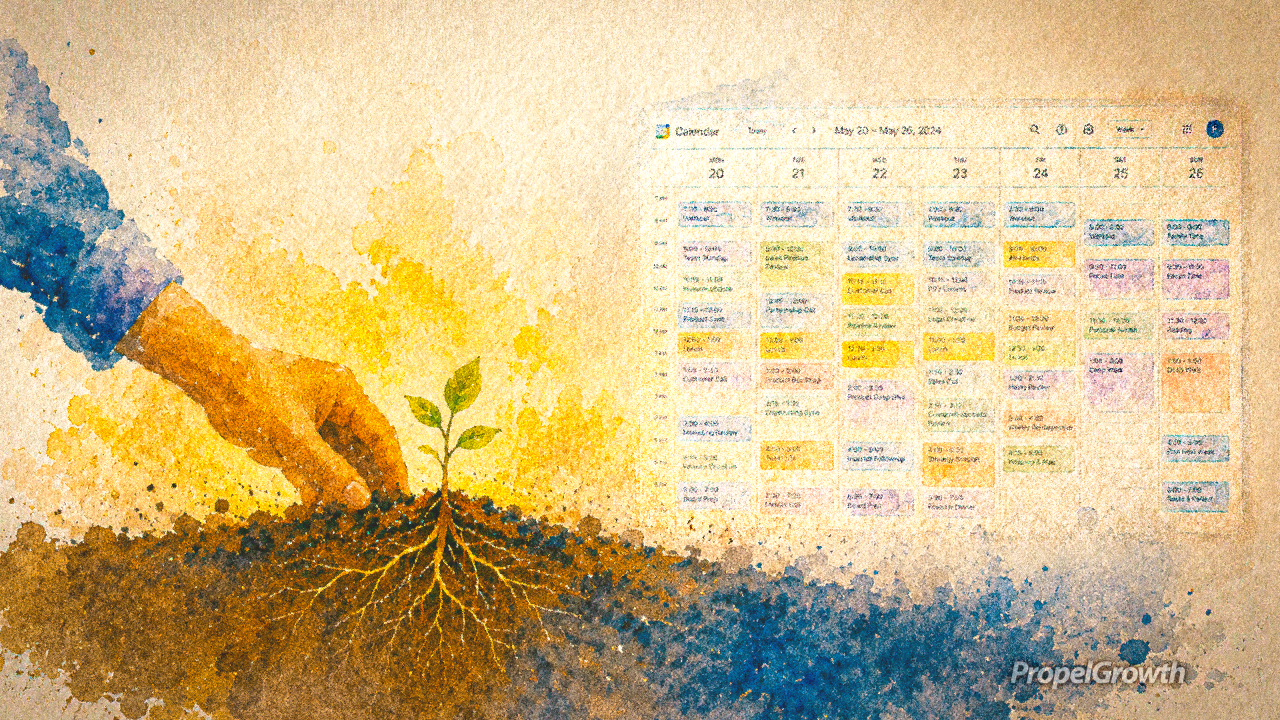
Do you have time to build a founder brand? The honest answer: you don't have time not to. Every quarter you stay invisible, cold outreach gets more expensive and the market decides who to trust while you're still invisible.
Every founder I talk to about building a brand on LinkedIn agrees it matters. Then comes the objection. It's almost always the same one.
"I don't have time."
I understand why it feels true. You're running product, hiring, fundraising, and putting out this week's fires. Posting on LinkedIn looks like one more thing on a list that's already too long.
But the objection rests on a hidden assumption: that building your brand is extra work stacked on top of your real job. It isn't. For a founder, it is the job.
The one job nobody else can do
Follow the logic.
Nothing else your company does matters if there's no demand. Not the product roadmap, not the hiring plan, not the funding round. No demand, no company.
Demand starts with someone making the market believe. Someone has to carry the vision, the direction, and the reason the company exists out into the world where buyers can find it. That's evangelism, and it's been part of the founder's job since long before LinkedIn existed.
And nobody in your company can do it like you can. You have the strongest voice, the deepest conviction, and the most credibility with buyers. People trust people, and they trust founders most of all. Your marketing team can amplify your voice. They can't replace it. If the CEO truly can't carry this, then whoever drives the company's vision and strategy must. But in most companies, that person is the founder.
So look at what "I don't have time" actually means. Almost everything else on your calendar has a possible delegate. This doesn't. When you say you don't have time to build your brand, you're saying you don't have time for the one job in your company that only you can do.
Craig Rosenberg puts it bluntly: you can't afford not to do this. He's watched cold outreach collapse while founder-led content fills the gap. And the founders doing it are seeing the results in hard numbers. For example, Gal Aga, CEO of Aligned, reports that 65% of his company's leads come directly from his LinkedIn content. Not from the company page. From him.
That's not a side project. That's a pipeline channel that only the founder can work.
You're already generating the content
You don't need to find time to figure out what to write, because you're already creating the ideal all day long.
Think about what you did this week. You explained your vision to a candidate. You answered a hard question on a sales call. You told a customer why their current approach keeps failing. You made a case to your board. Every one of those moments was content. It just evaporated because nobody captured it.
I know this because capturing it is part of what I do for a living. When I ghostwrite for founders, I don't ask them to write anything. I ask for their call transcripts. Then I dig through them for the questions buyers keep asking, the objections that keep surfacing, and the aha moments where something clicked for a customer. Twice a month, I interview the founder to go deeper on what I found. They talk. I listen. Then I turn what they said, in their own words and their own voice, into posts.
I have never found a founder who lacked content. They lacked a capture system. The raw material is pouring out of them on every call. I help them catch it.
You can build your own capture system without hiring anyone. Record voice memos after sales calls while your thinking is fresh. Pull transcripts from your customer conversations. Keep a running list of the questions you answered this week. Batch an hour on Friday to turn three of those moments into three posts. The founders who publish consistently don't have more time than you. They're prioritizing how they spend their time.
The other objections, answered
I hear two other categories of objections from founders.
"I'm not a thought leader." "I'm not an expert." "I'm not a writer."
These are all the same objection: "I'm not qualified."
And they all rest on the same error in judgement...assuming that you're performing for your peers. I made that mistake. I tried to be super smart and write for marketers. For years, my blog attracted my competitors...but not my customers. If I'd paid attention to what my customers were asking, I'd have realized much sooner that it was a lot easier to write for them.
You're not writing for the smartest competitors in your space. You're writing for buyers who are years behind you on a road you've already traveled many times. You've spent years focused on solving a specific set of problems. The founder who says "everybody already knows this" is comparing themselves to the five other experts in their space. But you're not writing for those experts. You're writing for the thousands of buyers who are struggling with what you consider obvious.
And "I'm not a writer" assumes writing is the skill required. It isn't. Talking is, and you already talk about this for a living. You can get help with the writing. For example, I take transcripts of calls founders are already having every week and then interview them. All they have to do is talk.
"I don't know what to write about." "People aren't interested in what I have to say."
Your customers already wrote your content calendar. The questions they ask on sales calls, the objections they raise, the misconceptions you correct over and over: that's the list. You'll never run out of ideas, because your market keeps adding to it.
And don't worry about repetition. It might seem repetitive to you, but for most of your audience, they're not seeing repetition. They're learning from you. Each time you cover a topic from a slightly different angle, you help them understand it more.
As for whether anyone's interested, well, they were pretty interested in that customer call you had last week. You know what topics interest them, they live in the customer questions and objections.
And if your buyer from last week was interested in a topic, then it's very likely that dozens of other potential buyers are also interested in that topic, and are also asking those same questions to their AI chat tools. The only question is who's answering their questions in public: you, or your competition?
The cost of waiting
Every objection on this list has the same function. It postpones the start date.
But building market trust and driving demand is like the old proverb about planting a tree. The best time to plant the tree was 20 years ago. The second best time is today.
It takes 12 to 18 months of consistent presence before a founder brand delivers steady, measurable results, and that clock only starts when you do. Postpone a year, and you're not just a year behind where you'd have been. You're a year behind the competitor who started today. And your buyers spent that year learning someone else's answers to their questions.
You have time for this. What you don't have time for is another year of being the best-kept secret in your market.
This article is part of my founder brand series, which also includes Why a Founder Brand Is the Last Durable Competitive Moat in B2B, Why B2B Demand Generation Is Failing (And How a Founder Brand Fixes It), Your Founder Brand Won't Sprout for a Year. Plant It Anyway., and Content Pillars for a Founder Brand.
About the Author
"Your biggest competitor isn't another firm—it's your invisibility."
Candyce Edelen helps B2B founders build a founder brand that drives visibility, credibility, and authority. She surfaces your expertise from your conversations with clients and shapes it into strategic LinkedIn content. This builds trust with buyers before they're ready to buy. The result: improved customer acquisition costs, higher close rates, and bigger deal sizes. Candyce has been building founder brands as part of a go to market strategy for for over 25 years. During that time, she’s interviewed more than 250 executive-level buyers, and those interviews have shaped her understanding of how to help founders build credible authority that drives business results.
Supercharge your prospecting and social selling on LinkedIn!
Get actionable tips to up your social selling game. You'll get ideas to help you optimize your LinkedIn profile, attract ideal leads, grow your network and book sales meetings with your ideal prospects.
Check your inbox and spam folder for a confirmation email. We hate SPAM and want to confirm your subscription before adding you to our list. We'll never sell or share your information, and you can unsubscribe anytime.

