
Why a Founder Brand Is the Last Durable Competitive Moat in B2B
Jul 09, 2026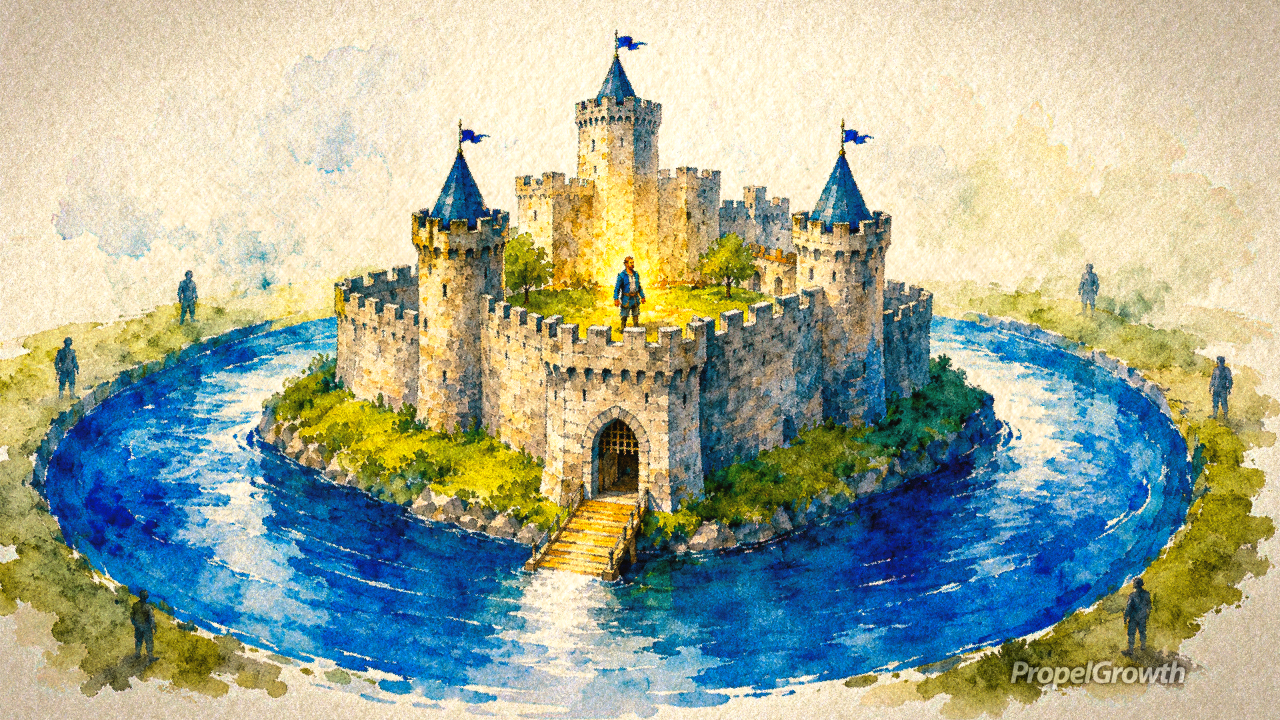
A founder brand is the last durable competitive moat in B2B. Competitors can use AI to copy your product, your pricing, and your content. But they can't copy you, and they can't copy the trust you build in the marketplace.
When I cofounded my first software company in 2000, our technology advantage bought us about 3 years before competitors caught up and surpassed us. So we had 3 years to come up with the next major advancement while still maintaining and improving version 1. By 2005, that technical moat had slipped to about 18 months. Then it bought you a year. Since AI emerged, tech advantage is measured in days. Anyone with AI and a free weekend can copy your product idea, your feature set, even your positioning.
Sam Jacobs describes how fast this compression happened. In the industrial era, structural advantages lasted decades. If you owned a railroad, a competitor couldn't raise a seed round, hire three engineers, and build a competing railroad. That took decades. In the enterprise software era, building out on-premise solutions protected incumbents, because nobody wanted to rip out core systems. The more embedded we could make the software, the easier retention became. Then SaaS made deployment easy and switching easier. Competition could easily overcome each others' moats.
Now AI compresses the half-life again. Building got easier. Copying got easier.
Most founders respond by running faster. Stay one step ahead. Keep shipping. Keep hoping.
But that's a treadmill, and it's inevitable that someone faster is going to join the race. Hope is not a strategy.
As Sam Jacobs pointed out, running faster isn't a moat. It's cardio.
What a moat actually is
A moat is an advantage that endures. It's a fundamental part of your business that stops competitors from walking up and taking what you spent years building. Moats make you harder to copy, harder to displace, and more expensive to compete against.
Test your current advantages against that definition. Product? Copyable in days. Execution speed? A treadmill. Distribution? Fragile, and you don't control it.
There's one thing left that a competitor can't download, clone, or vibe code: the trust your market has in you.
Trust compounds. Every useful thing you say adds to it. It shapes market belief and preference in your favor, and it keeps working when you're not in the room. A competitor can copy your feature list overnight. They cannot copy three years of your market watching you showing up in conversations, saying useful things, and being helpful.
How trust actually gets built
No channel lets you reach your whole audience, or even one person, 100% of the time. LinkedIn throttles reach. Gmail filters the inbox. At a conference, you're up against every other speaker. Even if they're in the room, their phones can distract them. Attention is fragmented and distribution is fragile.
So attention alone can't be the goal. The goal is memory. Memory is the durable residue of attention.
And memory alone isn't enough either. It has to connect to trust. You say something useful. Your audience remembers it, and they remember you as someone who says useful and helpful things. You get connected to the category. You become associated with a problem. You keep helping people understand that problem better. When the need shows up, you're the one they remember. More importantly, you're the one they TRUST. That progression, from visibility to credibility to trust, has a specific order and timeline.
That's why your audience is not your asset. Follower counts and email lists are just access. Your asset is the trust that survives beyond any single post, comment, or presentation.
You can see the difference in how companies treat their markets. Strong brands give. They share useful ideas and help buyers understand themselves and their problems better. Weak brands treat buyers like prey: gated reports, sales sequences, every interaction a measurable conversion path. You can't annoy a person into buying from you.
"I don't have time for this"
I hear this from founders constantly. They'll get to brand building later. Right now they're heads-down on product, on this quarter's pipeline, on the next release.
That's like a farmer saying he doesn't have time to plant, weed, or fertilize.
He's not wrong that it takes time. Preparing soil, planting, and cultivating take far more effort than harvesting does. But skip the planting and I can promise you two things. You'll have plenty of free time next season. And you'll go hungry.
Trust works the same way. It takes repeat exposure over months to build, and there's no way to rush it. The founders who start now will be uncopiable in two years. The founders who wait will still be on the treadmill, shipping faster and wondering why the pipeline keeps thinning.
Your product won't protect you. Your speed won't protect you. Your biggest competitor isn't another firm. It's your invisibility.
This article is part of my founder brand series, which also includes Why B2B Demand Generation Is Failing (And How a Founder Brand Fixes It), Your Founder Brand Won't Sprout for a Year. Plant It Anyway., Content Pillars for a Founder Brand, and You Don't Have Time Not to Build Your Founder Brand.
About the Author
"Your biggest competitor isn't another firm—it's your invisibility."
Candyce Edelen helps B2B founders build a founder brand that drives visibility, credibility, and authority. She surfaces your expertise from your conversations with clients and shapes it into strategic LinkedIn content. This builds trust with buyers before they're ready to buy. The result: improved customer acquisition costs, higher close rates, and bigger deal sizes. Candyce has been building founder brands as part of a go to market strategy for for over 25 years. During that time, she’s interviewed more than 250 executive-level buyers, and those interviews have shaped her understanding of how to help founders build credible authority that drives business results.
Supercharge your prospecting and social selling on LinkedIn!
Get actionable tips to up your social selling game. You'll get ideas to help you optimize your LinkedIn profile, attract ideal leads, grow your network and book sales meetings with your ideal prospects.
Check your inbox and spam folder for a confirmation email. We hate SPAM and want to confirm your subscription before adding you to our list. We'll never sell or share your information, and you can unsubscribe anytime.

